Showing posts with label mathematics. Show all posts

Saturday, June 6, 2015

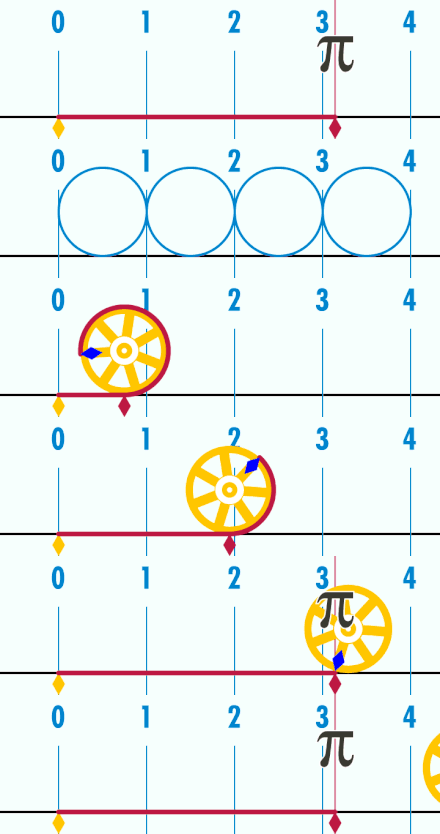
Proof - PI is irrational


                                                    [image source: wikipedia]
 Lets assume PI is rational.
Then PI = a/b, a and b are integers.

We also know pi is not an integer as its value lies between 3 and 4.

We know the equation:

e^(i PI) = -1

substituting its rational form:
 e^(i * (a/b)) = -1

raising both sides to bth power.
e^(a i) = (-1) ^b

now there are two cases:

1. b is odd.
in this case e^(a i) = -1
this means cos a = -1
this implies a is an odd multiple of PI. That is PI, 3PI, 5PI etc. As cosx  takes -1 only in these points.
but we know PI is not an integer. so a is not an integer either.

2. b is even
in this case e^(a i) = 1
this means cos a =1
this means a is an even multiple of PI. That is 0, 2 PI, 4 PI etc.
but again 2 PI etc. are not integers. So only option left is a = 0 which would mean PI = 0!

This proves by contradiction that PI is irrational.

Sunday, October 19, 2014

Godel's theorem for layman

In mathematics we use:
  1. a set of assumptions (axioms) and 
  2. use a set of rules for deriving conclusions (inference)
  3. Proofs are statements which are derivable from axioms using these rules.
A system is consistent if we can only prove true statements.  That is we can't prove a statement and its opposite.


For example, we can't prove both 2+2 = 4 and 2+2 != 4 in the system. Only one can be proven.

Now we know we can't prove both. Do we know we can prove the true one in all cases?

Godel theorem says no. In a consistent system, there will always be statements which are true but not provable! Sounds odd, but that's exactly the reason the theorem is puzzling and popular!

              THIS STATEMENT IS NOT PROVABLE


The implication is although mathematicians may be working on things like Fermat's last theorem they may not provable even if they are true. So they may be just wasting time [in some sense] trying to prove it. Of course Fermat's last theorem itself was provable and proved by Andrew Wiles.


Sunday, December 15, 2013

Continuum hypothesis for layman


We have at least 2 different kinds of infinities:

1. Integers and all the other countable numbers - That is things you can pair with integers.


For instance pairs: {1, 1}, {1,2} ...

These can be easily paired integers along diagonals:


                            {1   1}     {1 2}    {1 3}

                            {2   1}     {2  2}
                            
                             {3   1}

We can easily pair like so:
1 -> {1 1}
2 -> {1  2}
3 -> {2  1}
4 -> {1  3}
5 -> {2  2}
...

So pairs  [fractions being one of them with equivalence class notion on top] are no 'bigger' than integers.

2. On the other hand real numbers are really bigger than integers!


Courtesy:Wikipedia

There is a nice way to prove this due to George Cantor.

In fact we need to only consider real numbers in {0, 1}

if it is countable, We can write this as:

1-> 0.0000...0
2-> 0.0000...1
   0.0000..2
   ..
   0.9999..9
Now if we go along the diagonal and change 0 to 1 and everything else [1, 2,...9] to 0 we get a number which differs from all these numbers in atleast one position and it is not mappable to an integer!

So real numbers are indeed bigger, in fact way way bigger! In fact they are not even real despite their name!

Now the continuum hypothesis asks whether there is an infinity strictly between integers and reals or reals are the next big infinity. Of course hypothesis claims it is true.
No one has been able to prove or disprove this in more than a century!


Monday, October 7, 2013

Largest factored number


I was listening about Quantum computation in Quantum theory - lecture 15.

Suddenly I started wondering what is the biggest number [known publicly] to have been factored. As usual I turned to wikipedia.


This number known as RSA-768 is the hardest known number [having only 2 prime factors also called semiprime].

1 ]=> (* 33478071698956898786044169848212690817704794983713768568912431388982883793878002287614711652531743087737814467999489 36746043666799590428244633799627952632279158164343087642676032283815739666511279233373417143396810270092798736308917)

;Value: 1230186684530117755130494958384962720772853569595334792197322452151726400507263657518745202199786469389956474942774063845925192557326303453731548268507917026122142913461670429214311602221240479274737794080665351419597459856902143413


If we purely go by digit size it is:

 1061
2   - 1 

it is 320 digits!

Sunday, February 20, 2011

Elegant integration of sinx/x from 0 to infinity


I learned two things called Contour integral and Jordan's lemma today.

It helps solve this integral elegantly.

To evaluate this you can use e^iz/z and integrate it over 2 semi circles and 2 line segments and residue theorem to convert this into evaluation of this integral. It is really elegant.
It uses Jordan's lemma along the way to make one of the semi circle integral 0 as its radius R goes to infinity.

Monday, January 24, 2011

Nice putnam question

Prove that this is not prime for any n.

I found this question in putnam question paper and it has real elegant solution too.
It is too good to not to solve it yourself.

Saturday, January 8, 2011

Greatest mathematicians ever!

I got a question today in aardvark - who are greatest 20th century mathematicians?

I answered Turing, Godel and Von Neumann.

Then I searched in google about who are greatest mathematicians. I saw many lists and I decided to create my own list based on my own knowledge - of course it need not be objective as it is my own list!

My criteria are a bit harsh - If two people invented the same thing, the person who invented it first or Who is more influential in other respects are given the credit. One good example is evolution. We always credit it to Darwin although Wallace came up with the idea around the same time. So credit for calculus goes to Newton not his opponent. Also I give more credit for a great foundational discovery than breadth of output - Best example is Euler for the latter - but Godel beats him with his incompleteness theorem.
1. Sir Isaac Newton
Greatest by a long distance to me. His invention of Calculus alone would have placed him here. But he discovered binomial theorem, Newton's method for square roots etc.
2. Carl Frederich Gauss
Greatest pure mathematician [or at least one mainly known for mathematics]. He discovered many things like Non Euclidean geometry, Gaussian curvature etc.
3. Kurt Godel
He found incompleteness theorem, which shattered the hope for a theorem proving machine which will find all theorems.
4. Archimedes
From his writings I can see he almost invented integral calculus. Particularly have a look at things like his approximation for PI.
5. Riemann
Invented things which were precursor to General Relativity [Riemann curvature] and a rigorous definition for Integral calculus and contributed to the theory of prime numbers [Riemann zeta function]
6. George Cantor
He proved real numbers aren't countable - so vastly bigger than natural numbers using his famous diagonal slash argument.
7. Alan Turing
He discovered the theory of computability with his Turing machines. It provided the formal basis for computers and proved there are things in Mathematics which are un computable.
8. Euclid
I think he is more of a chronicler than discoverer. But since I don't know who actually discovered his results I might as well give him the credit. Of course he gets into the list due to Elements.
9. Euler
I have to include Euler for the sheer amount of his work. On complex numbers like Euler's formula or his discovery of the sum of 1/1^2+1/2^2 etc. Although in my personal opinion none of them are as path breaking as others in the list.
10. Dedekind
I am including Dedekind for his rigorous definition of real numbers [which are anything but real!] - Although we should probably mention people like Cauchy and Weirstrass, I still think single most important was that of Dedekind.
Tuesday, December 21, 2010

Basel problem

I was thinking about the sum of the infinite series,

Sigma(1/N^2) which sums to PI^2 /6.

I heard this mentioned in the middle of a lecture and tried to solve the problem. When I didn't get any good idea, I cheated and looked at wikipedia to realise it is called Basel Problem.

It has an amazing history behind it. This is the first problem which made Euler famous.
I also his proof given in the wiki page, is elegant [but not rigorous my modern standards]. But more importantly I was amazed to know its value eluded the best of mathematicians of his day! and here was me, sitting and trying to derive the result in 10 minutes.

By the way, generalisation of this is called Riemann Zeta function, with this having value Z(2). So I guess you can think of the generalisation yourself.

Wednesday, August 26, 2009

Real analysis and calculus videos on youtube

Nice videos on real analysis and calculus. It starts from real fundamentals. It is really really good! Taught by IIT professor!
http://www.youtube.com/view_play_list?p=3A87B93CB9912EC1

Wolfram Alpha computational engine


Amazing engine - It produced results for almost anything I typed in. Elliptic integral, derivatives and what not! Beautiful! I am really humbled by the creators of this Engine!
It computes anything!

Friday, September 5, 2008

Most irrational number

Yes - there is such a thing as most irrational number.
Here is a nice article from american mathematical society:
http://www.ams.org/featurecolumn/archive/irrational1.html
You will be even more surprised to know it is none other than golden ratio. As you may already know it has relations to fibonacci numbers.

Monday, August 25, 2008

Dirac equation for electron in layman terms!

What Great Dirac simply did was to take the square root of


He did this simply by assuming this to be equal to square of this

which could only be solved if A, B etc. are matrices because AB= -BA and so on!
more over we can get 4 such matrices only if we go to 4 dimension. There are not enough matrices to go in lesser dimensions.
that's it - it is just a matter of finding these 4 matrices of size 4x4.
But implications are amazing - we get electron spin as well as anti - electron!
Pure beauty of mathematics!


Wednesday, August 20, 2008

A beautiful equation

e^i pi + 1 = 0
What a beauty of an equation is this - connects so many fundamental mathematical constants - 0, 1, pi , i and e.
It says all profound concepts in mathematics is fundamentally interconnected.
But I don't like Euler because of his God's existence "proof".

Tragic Logarithmic spiral

Path of an insect flying to a candle is a logarithmic spiral.
It's defining property is angle to the line from centre [candle] and tangent of insect path [instantenous direction of velocity] is constant.
r = ae^bt
t - is an angle.
The reason is they are used to doing this from old times when only sun and moon was there, in which case it led to straight line path.
Unfortunately not anymore, after this species called homo sapiens usurped the planet.
http://en.wikipedia.org/wiki/Logarithmic_spiral

Friday, June 27, 2008

Real numbers!

Or dedekind complete ordered field - yes that is the mathematical definition of real numbers!!
This link is very good and explains it very beautifully in accessible fashion:
http://www.math.vanderbilt.edu/~schectex/courses/thereals/
It explains the contents of Robert Bartle's real analysis book in a single page. Author has some talent in explaining hard things to people!
Real numbers are not so real after all. They are mathematical constructs as much as say complex numbers.
So we have no reason to expect real riemannian manifolds will explain the universe [spacetime] - In my thinking it should be discrete.

Tuesday, May 27, 2008

circumference of an ellipse!

Somehow I never thought about the circumference of an ellipse.

Oh what is there to think about? It is one of the "kid" curves our ancestors figured out, right?Although I am an Indian, most likely my ancestors too - not just Greeks - at any rate it is not as complicated as exponentials and logarithms which form the basis of decimal system - anyone remember having problems with carry in addition in their second standard? [include me as your brethern]

Of course figuring out length of the curve is the most simplest thing taught to me 13-14 years ago at which time of course I sort of cursed myself, that I didn't figure such a simple thing myself - it is just pythogoras thorem

dr^2 = dx^2 + dy^2
and of course I want to find r from dr just integrate over it, so simple ah?
Anyway to come back to main story - Yesterday after reading about classical mechanics and then just to relax I was reading Dawkins' God delusion - [A very good book BTW to give to your religious friends] and somehow my attention turned to earth's orbit and I was thinking why would people think orbit should be circle, especially if it is very improbable configuration among all ellipses. Then I wondered what is the average velocity with which we fly through the space.

It is simply our [earth's] orbit length divided by 365 days! But I didn't know orbit length.

But I knew it is an ellipse - So I wanted to calculate the circumference of the ellipse.
So I duly wrote the equation
x^2/a^2+y^2/b^2=1
and started integrating
sqrt(1+(dy/dx)^2) dx
I didn't even have a hint of what is coming. So I got a nasty expression in terms of x and y s and I thought converting into parameteric form may be easier to solve.
I set x= acos(theta)
...
to cut a long story short
I ended up at

and whatever I do I couldn't solve it. Then today I came and looked on the net [cheating] for circumference of ellipse and sure enough they stop here too and call it 'complete elliptic [obviously] integral of second kind'

http://en.wikipedia.org/wiki/Ellipse

it has only an infinite series solution and an approximation by Ramanujan!
Sometimes things we take for granted turn out to be so complex!

Thursday, April 3, 2008

Frobenius series!

The other day I learned about frobenius series method to solve differential equations.
It was like flying in heaven! Nice and common sense way to solve.
Try solving one of legendre or lagurre differential equations with this method. You will absolutely love it.

http://www.physics.miami.edu/~nearing/mathmethods/ode.pdf

Saturday, March 15, 2008

Thursday, March 6, 2008

Why complex vector space inner product is defined with conjugate symmetry?

If you don't use conjugate but simple symmetry it will produce a contradiction with the axiom X . X >= 0

assume X.Y = Y. X

X.X >=0

=> c1 X . c1 X >= 0 [where c1 is a complex number with an imaginary part]

=> c1 (c1 X . X) > = 0 by linearity

=> c1 (X . c1 X) > = 0 by symmetry

=> c1 . (c1 ( X. X) )>= 0 by linearity

=> (c1 . c1) . (X.X) > = 0 by associativity of complex numbers

which is a contradiction.

to see this, if you take c1 = i [square root of -1]

=> -1 (X.X) >= 0

=> (X.X) <= 0

cool, right?

Thursday, January 24, 2008

God Created The Integers

God Created The Integers: The Mathematical Breakthroughs That Changed History

Edited by Stephen Hawking

it is one of the most beautiful books [or rather collection] I read. It has great works from all the mathematicians! you really come to understand what people like Euclid, Archimedes or Descartes did!

what is the big deal about drawing to straight lines at right angles and calling them x and y respectively, right?

You will really appreciate how intelligent ancients [India, Greece etc.] were.

Must have for every mathematics or science enthusiast!