Showing posts with label physics. Show all posts

Monday, November 25, 2013

How do we know neutrinos exist


I was wondering today why should we postulate neutrinos and make life more complicated than it already is.


This article explains why neutrinos are required and in addition as a bonus explains how they are detected. Apparently it is must for accounting for conservation of energy in beta decay.

Story of the Neutrino


Saturday, November 2, 2013

Is there an opposite of absolute zero temperature?


That is do we have a highest possible temperature in the universe?

We know we have a lowest possible temperature  [−273.15° Celsius] when all particles of the system have no kinetic energy at all.

I was wondering is there an opposite of absolute zero and looked up in the net.

These two articles discuss this. Apparently it goes to the heart of physics!

Current contender is Planck temperature at
                     32
1.4 x 10 
 
PBS - absolute hot

and

http://en.wikipedia.org/wiki/Absolute_hot


Saturday, September 28, 2013

Great Perimeter institute physics videos

I found very good set of physics course videos in perimeter institute recorded seminar archive.

I am going through these 2 courses and they are very good and highly recommended.

1.  Advanced General Relativity

This course introduces general relativity at advanced level as the name implies. Prof. Sorkin is very smart and good teacher despite his soft voice!


I enjoyed the explanation of Covariant derivative and Lie derivative in particular. It gave me an intuition in to why covariant derivative is inextricably linked to metric and very intuitive explanation of Lie brackets as the "inability of the parallelograms to close".

2. Quantum Theory

It introduces quantum theory again at an advanced level. Prof. Emerson again is very good teacher and has a good voice as a bonus.


I am only half way through the course so far. I enjoyed the foundation discussions in lecture 7 and more importantly the connection between classical and quantum mechanics in lecture 8. Latter gave an intuition about why jumping of state is not so different from classical probabilistic "state update rule" and surprisingly where they differ is after the measurement we DO NOT see the outcome.
1. In Quantum mechanics coherent superposition is destroyed and it definitely is in one of the eigen states [although we didn't take a look at the actual state!]
2. In classical mechanics "coherent superposition" remains in the sense same probability density function continues to apply.

This was very interesting observation and came us a surprise to me! This point alone was the worth effort I spent in learning these videos.


Sunday, May 19, 2013

How long does it take to jump from San francisco bridge?

How long does it take to jump from San francisco bridge? That is how long a person would be in free-fall?

Golden gate bridge elevation is 67 meters.

So using high school physics:

 distance = 1/2 g t^2

67 = 1/2 * 9.8 * t^2

This gives in my scheme interpreter for time of 3.7 seconds:

(expt (/ (* 67 2) 9.8) 1/2)

;Value: 3.697765458727081

Speed

What would his speed be at the time of his free-fall experience broken?

 speed = gt

(* 9.8 (expt (/ (* 67 2) 9.8) 1/2))

;Value: 36.2381014955254


That is 36.24 m/s!

or:

(* 3.6 (* 9.8 (expt (/ (* 67 2) 9.8) 1/2)))

;Value: 130.45716538389144

 130 KM per hour or close 81 M/hour - Nasty!

Force

What would be the force?

F = d(MV)/dt

So for a person of 70 KG, assuming the final splash down happens in 1 micro-sec in Newtons:

(/ (* 70 (* 3.6 (* 9.8 (expt (/ (* 67 2) 9.8) 1/2)))) .01)

;Value: 913200.15768724


This is equivalent to 91 TON on top of the person - or close to 45 elephants on Top crushing the bones! Not very nice way to go!


Monday, August 27, 2012

What is Temperature?


I was thinking about what is Temperature.


What it means for something to be in particular temperature? I looked around in the net, and learned that it is simply average kinetic energy of molecules.

If something is hot, the molecules in that something is moving around or oscillating faster. In the case of metals it is electrons. If something is cold, the molecules are relatively slow.

Why do we feel hot when we touch a hot object? The molecules in the object collide pretty hard on our fingers, trying to disturb our cells which is felt by our neurons as 'hot'.

Why do we feel cold? When molecules in the air is taking away average kinetic energy from us through collisions and we lose energy [heat].


Sunday, July 17, 2011

Standard model looks ugly...


I was reading http://en.wikipedia.org/wiki/Subatomic_particle

Elementary particles of the Standard Model include:[2]
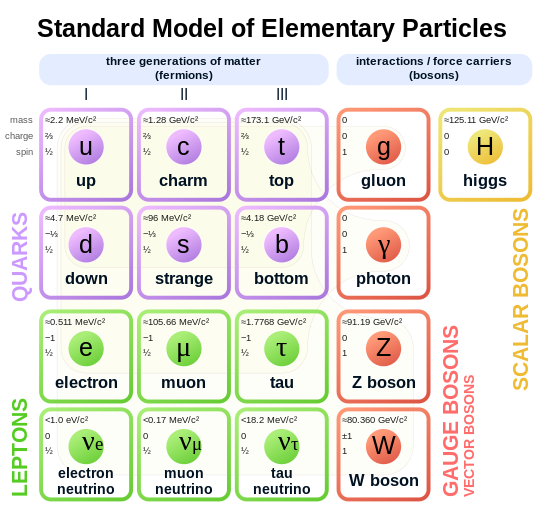
Six "flavors" of quarks: up, down, bottom, top, strange, and charm;
Six types of leptons: electron, electron neutrino, muon, muon neutrino, tau, tau neutrino;
Thirteen gauge bosons (force carriers): the graviton of gravity, the photon of electromagnetism, the three W and Z bosons of the weak force, and the eight gluons of the strong force.
and was thinking to myself, holy crap - standard model for sure looks ugly. It looked more like intelligent design theory of physics rather than theory of evolution - that is every particle [species] was created independently instead of being essentially variation on the same thing .

So I looked in the net and even Great Stephen hawking seems to feel that way!

If we understand the universe, then we control it, in a sense. The standard model is clearly unsatisfactory in this respect. First of all, it is ugly and ad hoc. The particles are grouped in an apparently arbitrary way, and the standard model depends on 24 numbers whose values can not be deduced from first principles, but which have to be chosen to fit the observations. What understanding is there in that?

Clearly something needs to be done, and it is not complicating life more by introducing multiple universes [To me all the universes comprise to become one true universe - which is what I would call THE universe. No universes] - It is inaccessible to us is irrelevant. Even in our universe, observable part is not the whole universe - It is only what is called 'observable universe'.

Tuesday, January 11, 2011

How to become good theoretical physicist

How to become good theoretical physicist.
't hooft is a Nobel laureate who worked in both general relativity and quantum field theory and great teacher.

http://www.phys.uu.nl/~thooft/theorist.html

Friday, January 7, 2011

How the distance from stars are measured

We all know it is using parallax. But I didn't understand how we can actually measure the parallax angle. Finally this link explained it well. It is because we know the angle subtended by telescope's field of view.

If whole picture is 10 degrees and picture width is 10 centimeter and star seems to move 1 centimeter its angle is 1 degree. of course at 1 degree we will be fried to death - but that was just an example!

Wednesday, August 26, 2009

Quantum physics videos on youtube

http://www.youtube.com/view_play_list?p=0F530F3BAF8C6FCC
Good set of videos on quantum physics! A bit hard because the material itself is!
It is by IIT professor and arranged by same nptel of ministry of education of india.

Monday, August 25, 2008

Dirac equation for electron in layman terms!

What Great Dirac simply did was to take the square root of


He did this simply by assuming this to be equal to square of this

which could only be solved if A, B etc. are matrices because AB= -BA and so on!
more over we can get 4 such matrices only if we go to 4 dimension. There are not enough matrices to go in lesser dimensions.
that's it - it is just a matter of finding these 4 matrices of size 4x4.
But implications are amazing - we get electron spin as well as anti - electron!
Pure beauty of mathematics!


Wednesday, August 20, 2008

Why we see in visible light?


I was wondering why we see in visible light?

By that I didn't mean why we see in "visible" light instead of "invisible" light! Whatever we see is visible light, by definition.

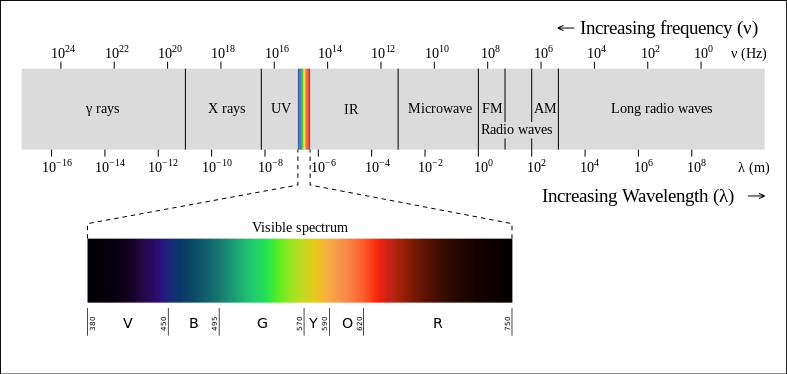
What I mean is why we see in the range 380 to 750 nm?

for example, our eye could have been sensitive to another portion of Electro magnetic spectrum For example, infra red could have been red, red could have been orange etc. and we don't see violet at all or the other way around.
That is the spectrum could have been 450 to 820 nm.
so what is special about visible part?
it is something special for we earth dwellers.
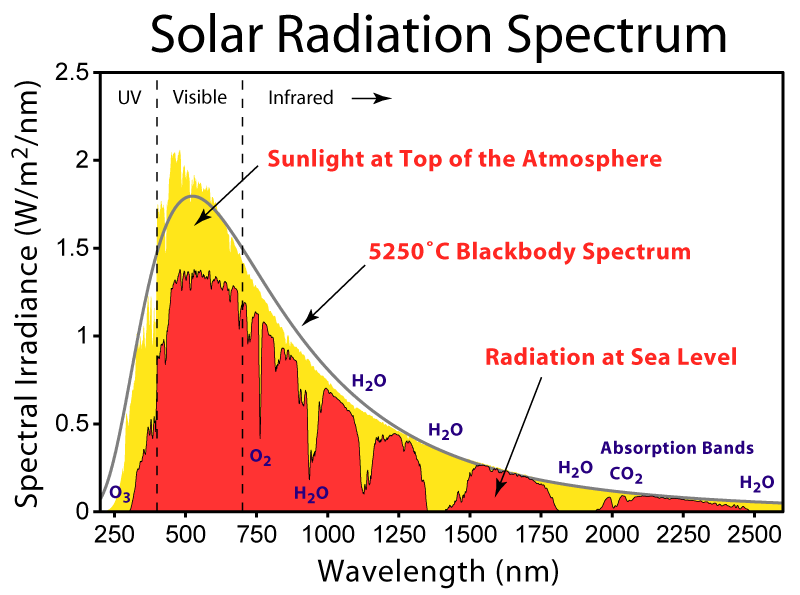
1. Sun's temperature being close to 6000K its blackbody radiation peaks at this range.
2. Earth's atmosphere has some set of Electromagnetic radiation windows with optical window with this same range being one of them.
This link explains more:
http://www.iop.org/EJ/article/0031-9120/42/1/002/pe7_1_002.pdf?request-id=274078a3-1121-4070-893f-5aabf8d9e489

A cute little fact is rattlesnakes have "eye" to see in infrared - to catch animals like us who radiate in infrared.
So if our sun were to peak in different wavelength range and our earth were to be atmosphere-less [or of different composition] we would be seeing different visible light!
Of course we would be seeing only visible light, by definition!

Sunday, July 27, 2008

standard model of particle physics

To me standard model looks so ugly. It looks like so many things thrown around with no conceptual coherence.
Compare this to something like newton's gravity, maxwell equations or relativity.
It makes me stop reading physics, if this is the real explanation for things.
It looks like the Mendelev's periodic table without the explanation in terms of electron orbitals.

Tuesday, May 27, 2008

circumference of an ellipse!

Somehow I never thought about the circumference of an ellipse.

Oh what is there to think about? It is one of the "kid" curves our ancestors figured out, right?Although I am an Indian, most likely my ancestors too - not just Greeks - at any rate it is not as complicated as exponentials and logarithms which form the basis of decimal system - anyone remember having problems with carry in addition in their second standard? [include me as your brethern]

Of course figuring out length of the curve is the most simplest thing taught to me 13-14 years ago at which time of course I sort of cursed myself, that I didn't figure such a simple thing myself - it is just pythogoras thorem

dr^2 = dx^2 + dy^2
and of course I want to find r from dr just integrate over it, so simple ah?
Anyway to come back to main story - Yesterday after reading about classical mechanics and then just to relax I was reading Dawkins' God delusion - [A very good book BTW to give to your religious friends] and somehow my attention turned to earth's orbit and I was thinking why would people think orbit should be circle, especially if it is very improbable configuration among all ellipses. Then I wondered what is the average velocity with which we fly through the space.

It is simply our [earth's] orbit length divided by 365 days! But I didn't know orbit length.

But I knew it is an ellipse - So I wanted to calculate the circumference of the ellipse.
So I duly wrote the equation
x^2/a^2+y^2/b^2=1
and started integrating
sqrt(1+(dy/dx)^2) dx
I didn't even have a hint of what is coming. So I got a nasty expression in terms of x and y s and I thought converting into parameteric form may be easier to solve.
I set x= acos(theta)
...
to cut a long story short
I ended up at

and whatever I do I couldn't solve it. Then today I came and looked on the net [cheating] for circumference of ellipse and sure enough they stop here too and call it 'complete elliptic [obviously] integral of second kind'

http://en.wikipedia.org/wiki/Ellipse

it has only an infinite series solution and an approximation by Ramanujan!
Sometimes things we take for granted turn out to be so complex!

Saturday, May 17, 2008

what the heck is [electron] spin?

This is the kind of thing which drives me nuts in quantum mechanics.
What is this spin with values like h*/2?
electron doesn't rotate on its own axis, right? So what is the meaning of this angular momentum? I know only the I x W
why it behaves like angular momentum if it is not one?
and the misnomer spin totally trips me off.
Really if someone claims he understands QM, what is this thing? [forget uncertainty principle etc.]

principle of least action

Actually principle of extremal action - why should it be true?
Meaning in the ultimate sense - why should universe follow it? not in the sense we can derive newton's 2nd law from this.
what is this thing called action?

I can [sort of] understand energy, force, displacement etc. What is this? It looks like ultimate cooked up thing.

atleast hamiltonian H [in conserved case], I can think of as energy.

But what is this Lagrangian?
[I know QM generalises it to all the paths. So least action is just special case - but still what is it, that it is generalising?]

Thursday, April 3, 2008

Frobenius series!

The other day I learned about frobenius series method to solve differential equations.
It was like flying in heaven! Nice and common sense way to solve.
Try solving one of legendre or lagurre differential equations with this method. You will absolutely love it.

http://www.physics.miami.edu/~nearing/mathmethods/ode.pdf

Saturday, December 22, 2007

length and time are discrete (granular)?

I think space and time [which is one and the same thing because you can convert one to another by just going fast! and light speed connnects the length and time - in fact that's how unit of length is defined nowadays] ultimately has to be discrete.

Think about this:
How do we measure time?
By some periodic process like sunrise or motion of pendulam or nowadays oscillations of quartz crystals etc.
Notice that we are gradually improving the smallest unit ["quantum"] of time we can measure.

In fact time is nowadays defined as:

The second is the duration of 9 192 631 770 periods of the radiation corresponding to the transition between the two hyperfine levels of the ground state of the cesium 133 atom.

So currently it is smallest unit of time we can measure roughly 10^-10 of a second.
Breathtaking by human standards but think about it:
it is only mere 10 positions after decimal point. To goto continous time we need millions and millons of digits!

But any physical periodic process will have an ultimate period. Pick the smallest of such a process. That has to be the smallest unit of time with any meaning. what does it mean to say 1/2 of that time? 1/10 of it? how do you measure, "feel" it? what about √2 part of it?
To me period of that process is the ultimate quantum of time.

In fact in my view, real numbers themselves are huge mathematical abstraction living in plato's world. It is no better [in fact worse] than complex numbers!

Now since time is discrete, space has to be too.

Saturday, December 8, 2007

Good introduction to Topology!


Very nicely written.

I enjoyed reading ephsilon -delta notation after long time!

Dr David Wilkins is really doing a service by putting it on the web!

Sunday, November 18, 2007

what's wrong with absolute time?

Ever wondered about this? It is [relatively] easy to see there is no absolute space [and easy to digest]!
What's wrong with assuming an absolute time ticking away in the background? Read this:

http://www.phy.syr.edu/courses/modules/LIGHTCONE/minkowski.html

In one line - Concept of simultaneouty is not absolute!